

Video summary (~7 min) · Read Time (~25 min)
Brief History: The Architecture of Authority
We talk about God-State-Network as the three leviathans of the 21st century; a new war of worlds fought between ideology, sovereignty, and cryptographically enforced community. But this isn’t a new fight. It’s the oldest political power struggle in civilization, just reanimated in code, fiat, and faith.
To understand how a decentralized Network can challenge the entrenched power of the State, we must trace the lineage of this triadic structure. The modern Network State is not a novel political form; it is the return of the intermediate sovereign—the force that historically sat between the ultimate source of truth (God) and the temporary wielder of force (the State).
The idea of three distinct, interacting spheres of power was forged in the crucibles of medieval and early modern conflicts.
The question was always simple: Who is the boss of the boss?
The Dual Authority (The Split) For centuries, power was simply bifurcated: the Spiritual and the Temporal. In 494 AD, Pope Gelasius I established the principle of Duality: the world is governed by the sacred authority of priests and the royal power. This effectively placed a layer of divine authority above the State, giving the Church standing to check the King. Architecture: God → (Church || State).
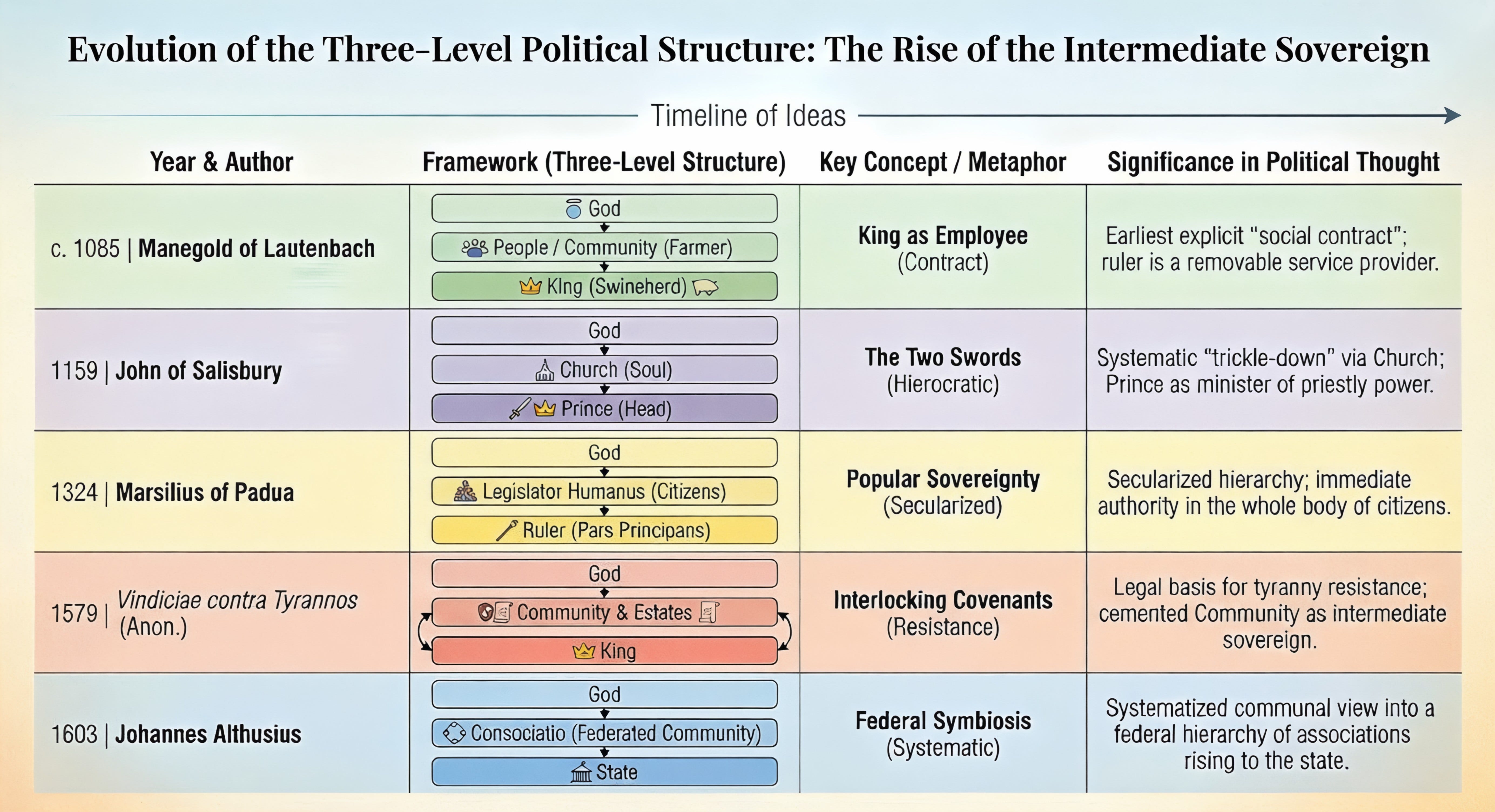
The Pivot: The King as Employee The radical shift toward the “Network” model, where the community mediates power and didn’t wait for the Reformation. It began in the 11th century with Manegold of Lautenbach.
Breaking with the idea that Kings answered only to God, Manegold introduced a proto-contractual theory. He argued that a King is merely an officeholder, comparable to a swineherd hired by a farmer (the people) to tend the pigs. If the swineherd slaughters the pigs he is meant to protect, the farmer is not only right to fire him, but obligated to do so. This was the birth of the “State as Service Provider” concept.
By 1324, Marsilius of Padua had systematized this in Defensor Pacis, arguing that the “Legislator Humanus” (the whole body of citizens) was the true vessel of God’s authority, not the Pope or the King. Architecture: God → People → State.
The Legal Formalization (The Contract) This medieval populism was weaponized during the late 16th-century religious wars. The Monarchomachs (”King-fighters”) needed a legal framework to resist tyranny. Their solution, detailed in the 1579 treatise Vindiciae contra Tyrannos, was a pair of interlocking covenants:
Covenant 1 (The Ultimate Law): A contract between God, the King, and the People. This bound the entire nation to Divine Law (Truth).
Covenant 2 (The Political Contract): A separate contract between the King and the People. The People, acting as the representative of God’s will, granted the King authority conditionally.
Crucially, the King did not receive power directly from God; he received it through the Community. This established the Community (the People, the Estates) as the intermediate sovereign that institutes, and can “delete”, the State.
The Modern Community: In 1603, Johannes Althusius systematized this view, defining the State as a “consociatio” built from smaller, foundational communities. The core dynamic was set: God/Truth is the source, the Community is the legitimate mediator, and the State is merely the conditional enforcer.
If you substitute the historical terms, the parallel is stark:
1085: God → The People (Farmer) → The King (Swineherd)
1579: God → The Community → The Sovereign
2025: God → The Network → The State
The Network State is simply the return of the “Community” as a digitally native, cryptographically aligned force, capable of resuming its historical role as the intermediate sovereign. The fight is about reclaiming the middle position in the oldest political architecture known to man.1
Balaji Srinivasan calls the three Leviathans God, State, and Network. Each has offered a framework that elevates something greater than the individual, such as supernatural purpose, national identity, or collective projects, to bind people into cooperative units. As Srinivasan observes, in the 1800s people refrained from wrongdoing by fearing God’s judgement; in the 1900s by fearing the State’s laws; and now in the 2000s we are increasingly constrained by truth determined by our digital networks, such as social media and blockchains.
In short, religion, nationalism, and tribalism are a feature rather than a bug of humanity. These are deep drivers of solidarity, connection, meaning, and in-group identification.
However, each of these feature forces has a dark side.
Taken to an extreme, devotion to religion can lead to cults and theocracy.
Taken to an extreme, nationalism can lead to war and genocide.
Taken to an extreme, tribalism can lead to ethnic violence and polarization.
The key question is how to hold on to the beneficial aspects of shared identity while preventing fanaticism. This question is unusually urgent today as global forces, including technological, demographic, and ideological shifts, are reshaping what community and state mean.
Digital network technology is enabling new forms of collective identity, the so-called network state, while many nations see resurgent populism or sectarian unrest. It might be worth mapping the landscape of religion, nationalism, and tribalism in the context of emerging network-based governance.
Religion (God Leviathan)
What: Religion generally involves belief in supernatural agents or moral forces combined with rituals and communities. It creates a shared moral framework and collective identity. Emile Durkheim and others have long argued that religion functions as social glue. Collective worship and shared symbols bind strangers into a moral community. Contemporary research affirms this. Moralizing religions historically united diverse groups under a common ethical roof. In essence, religion can help maintain cooperation beyond kinship by making people feel watched by a higher power, and connected by shared faith.
Modern trends show mixed forces. On one hand, religious affiliation is declining in many Western countries. Pew reports that U.S. Christian affiliation dropped from about 77 percent to 65 percent in a decade, and secularism is rising. Trust in organized religion as an institution is similarly waning in polls. On the other hand, religion remains extremely salient globally. A large majority of people worldwide identify with some religion or spiritual belief, and in several regions faith is strong or even resurgent (for example, Pentecostal Christianity in Latin America or Hindu nationalism in India). Moreover, even secular causes (*cough* politics) often assume a religion-like fervor and symbolism.
Features: When functioning in a moderate way, religion fosters community service, altruism, charity, and ethical behavior within the group. Shared rituals and narratives create trust. Strangers who share a faith often cooperate more easily. Religious charity organizations deliver education, healthcare, and social support in areas where governments or markets fall short. Belief in an ethical God can deter crime in low-surveillance societies because people behave morally when they feel watched.
Mechanisms: Religions leverage in-group and out-group psychology. They define moral in-groups with commandments such as “our people do this, others do that,” often framing outsiders as less virtuous. The Big Gods theory suggests that religion spread because it allowed anonymous cooperation. Believing in an all-seeing deity reduced cheating in large societies by punishing would-be transgressors with supernatural deterrents.
Real-world examples: Early Christianity, which created networks of hospitality and hospitals, and medieval churches that unified fragmented European polities. Modern interfaith organizations build peace coalitions across divides. Extreme cases are also numerous. Cults like Jonestown in 1978 or the Rajneeshpuram or Osho movement in the 1980s in Oregon illustrate the dark side of cult devotion. In Rajneeshpuram, followers built a commune and attempted mass bioterrorism and political subversion to form a theocratic utopia. World history is marked by religious wars, inquisitions, witch hunts, and in modern times extremist terrorism such as ISIS or sectarian violence. Even secular ideologies can take on a religious fervor. For example, Marxism-Leninism’s quasi-mystical devotion to communism has been called a secular religion by some analysts.
Risks: Radical cults are one risk. Small groups with charismatic leaders can devolve into totalitarian communities with brainwashing, isolation, and illegal acts. Historical cases like the Waco siege in 1993 show cultish religion merged with militancy. Another risk is societal fracture. When religion intertwines with politics, whether in a theocracy or through official religion, it can suppress dissent and fuel intolerance, for example political Islamism in Iran or militant secularism acting as a negative cult. Identity conflict is a third risk. Highly religious societies may exclude minorities or label them heretics, provoking persecution.
Debates: Some secular theorists once predicted that religion would vanish in a post-ideological world, for example during the era associated with Francis Fukuyama’s “End of History” thesis, but the reality is more mixed. Critics point out that banning religious symbols can backfire and that faith remains integral to many peoples’ identity and resilience. Others argue that the communal aspects of religion could be replaced by civic humanism or digital affinity groups. Balaji’s network-state thesis suggests that technology and blockchains might ultimately perform the social function of religion, but skeptics note that digital ideologies often inherit religious-style zeal anyways (Bitcoin maximalists for example, lead to a specific irony where the replacement becomes the replica).

Nationalism (State Leviathan)
What: Nationalism is loyalty to a nation, an imagined political community defined by shared language, culture, or territory. Unlike religion, which can transcend ethnicity, or tribe, which can be kin-based and small, nationalism typically scales to millions and is embodied in a sovereign state. In the modern era, nationalism became a unifying ideology. People accepted citizenship and nationhood as primary identities.
Features: Nationalism has historically mobilized large populations for collective goals. The concept of the nation-state enabled modern democracy and mass armies. For colonized peoples, anti-colonial national movements drew on national pride to achieve independence. Even in pluralistic states, national identity can generate social solidarity. National holidays, anthems, flags, and constitutions give diverse citizens a common narrative, for example the melting pot patriotism in the United States. Benedict Anderson’s idea of the nation as an imagined community rests on the notion that nationalism fostered cohesion among strangers through print media and shared symbols. A Stanford Encyclopedia analysis notes that national awakening struggles have been both heroic and cruel, reflecting nationalism’s dual nature, which can validate self-determination but also justify suppression of non-nationals.
Mechanisms: Nationalism works by categorizing humanity into us and them. Educational systems and media inculcate national myths. A narrative is built around historical glories or victimhood, language, and symbols. Military service, pledges, and civic rituals reinforce the idea that the individual exists to serve the nation.
Real-world examples: Constructive examples include nationalism inspiring liberation movements, such as Indian independence and the decolonization of Africa, and national parks and monuments creating a sense of pride. Welfare states have been built under nationalist social contracts. Extreme examples include hyper-nationalism leading to ethnic cleansing and genocide. The Second World War and the Holocaust were driven by Nazi racial-nationalism. Rwanda in 1994 saw Hutu nationalism demonize Tutsis. Modern examples include far-right ethno-nationalist movements such as white supremacist groups in the West, militant Hindu nationalism in India, and militant Islamic nationalism. Even moderate patriotism can slip into xenophobia, for example anti-immigrant politics in parts of Europe or “America First” rhetoric.
Risks: Ultranationalist regimes can arise when nationalism merges with totalitarianism. Fascist or communist regimes often require loyalty to the state above all, such as the Juche ideology in North Korea or the cult of personality in Turkmenistan. International conflict is another risk. Two nationalist groups may both claim the same land or deny each other’s legitimacy, making wars more likely. The fragmentation of Yugoslavia in the 1990s exemplifies how nationalist narratives can suddenly unleash ethnic violence. Domestic division is a third risk. In multiethnic democracies, competing nationalisms or sub-nationalisms can paralyze governance or lead to secessionist conflicts.
Debates: Today’s debate balances national sovereignty against globalization, especially in a post-pax Americana world. Some argue nationalism is necessary for democracy and preserving cultural heritage. Others blame it for hate and argue for global cooperation or supranational identities embodied in projects like the European Union or the United Nations. Political theorists debate civic nationalism, based on shared values, versus ethnic nationalism, based on ancestry. Samuel Huntington’s Clash of Civilizations thesis claims cultural nationalisms are driving current conflicts, but many scholars now see economic and political factors as equally or more important.
Tribalism (Network Leviathan)
What: Tribalism refers to intense loyalty to a small group, a tribe, and distrust or hostility toward outsiders. In modern discourse, this can mean loyalty to an ethnic or kin group, a political faction, an online community, or any tight-knit in-group. Balaji interprets tribalism broadly as allegiance to a self-selecting group, the network, which functions as a mini-Leviathan for its members (or, his one commandment idea).
Features: Tribal bonds provide deep psychological rewards, including belonging, identity, and mutual aid. On small scales, such as families and local communities, this is how humans evolved. In politics and culture, tribes can create strong collaboration. Political parties, tribes of ideology, allow like-minded citizens to organize and achieve policy goals. Grassroots movements use tribal solidarity to mobilize, for example environmental activist networks or open-source tech communities. A beneficial aspect of tribalism is its bottom-up decentralization. No central power is needed to enforce norms, because the group enforces them internally. Clark and colleagues conclude that no group, not even one’s own political party, is immune from tribal bias. Our brains are wired to form coalitions wherever possible.
Mechanisms: Tribalism arises from basic cognitive biases. We quickly categorize others as friends or foes. We reciprocate favors within the group. We trust signals from those who share visible markers such as language, clothing, or shared rituals. Online platforms accelerate tribalism by allowing self-selection of homogeneous communities and algorithmic reinforcement. People follow those with whom they agree. This echo chamber dynamic heightens groupthink. A Reuters and EBSCO review notes that echo chambers foster a sense of tribalism, where individuals engage with information that confirms their beliefs while dismissing dissenting opinions. Over time, separate tribes can come to believe even basic facts differently, making compromise nearly impossible.
Real-world examples: Constructive examples include small communities such as cooperatives or neighborhood associations that rely on tribal trust. Workplaces or sports teams form healthy tribes, building loyalty and cooperation around shared goals. Diaspora networks, immigrant communities abroad, provide support and business networks. Extreme examples include ethnic or racial tribalism that becomes lethal. The Rwandan genocide in 1994 was tribal at its root, with Hutu versus Tutsi. Segregationist policies and racially motivated hate crimes are tribal behaviors. Even in democratic countries, hyper-partisanship can slide into tribal identity, where winning matters more than shared reality. Fringe political violence is the extreme case: ideology hardens into ‘us vs. them’ loyalty.
This is why I separate two kinds of network forces: Network power is legitimacy via coordination (attention, mobilization, narrative), but Network truth is legitimacy via verification (digital signatures, public ledgers, auditable records). Think social media consensus vs. cryptographically verifiable claims, though both fall under the broader “Network Leviathan” category.
Risks: Polarization is a central risk. Tribal factions within a society can halt any compromise. When different tribes hold entirely separate truths, national unity erodes. Social media amplification means tribes seldom talk to each other (or even date/marry each other). Violence is another risk. Tribal clashes can ignite quickly, especially when identity becomes politicized. Civil wars and riots often have tribal bases, whether ethnic, religious, or ideological. Identity supplants reason. If tribal loyalty becomes the highest value, individuals may ignore ethical norms outside the group, for example extremist parties that vilify any dissenters.
Debates: Some observers argue that what is called tribalism today is just traditional community life, such as strong families and local ties. Others worry that labeling groups as tribes is pejorative and oversimplifies multicultural identities. Regardless, data strongly show that humans naturally form closed affinity groups. The key question is how to align tribes with open societies.

Interplay Between Leviathans
A key insight is that religion, nationalism, and tribalism overlap in their structure. All involve devoting oneself to something larger than the individual. In each case, personal identity is subsumed by group identity, whether God’s people, the nation’s citizens, or the tribe’s members. This gives groups tremendous motivational power. Followers make sacrifices, commit time and wealth, and sometimes fight and die for the cause (Balaji’s version has been critiqued here and here).
Common crossovers are frequent. Religious ideas can merge with nationalism, as in concepts like Hindu Rashtra, Christian nation, or Islamist state, or with tribalism, as in sectarian strife where religious lines coincide with ethnic lines. Tribal loyalty often has religious overtones, such as divides between Orthodox and Reform within Judaism or Christianity. The concept of noble cause corruption shows up in all three. When fighting for a perceived higher good, adherents justify unethical tactics.
Beyond ideology, these forces also function similarly at the psychological level. Balaji’s Leviathan framing suggests that if God and State are losing sway, the Network takes up the role of the group superior. Crypto communities and online movements already share cult-like aspects, including unifying ideology, charismatic founders, and exclusive symbols like logos and memes.
Network-state enthusiasts often write manifestos and commands much like religious texts. My own Network State Manifesto explicitly lists “Moral Purpose, one commandment that unifies its citizens in zeal”, resonant with religious imperatives. Journalists critique that high-tech libertarians in some contexts are adopting apocalyptic or end times rhetoric that is strikingly similar to evangelical prophecies. The process of group devotion is pattern-invariant whether the idol is God, country, or blockchain, and each carries a risk of overreach.

The Causal Story
Why do these dynamics emerge? The causal story has roots in human evolution and social organization. Parochial altruism, the tendency to cooperate intensely within one’s group while competing with outsiders, likely offered survival advantages in early human groups. Anthropologists argue that cooperative tribes outcompeted more isolated individuals. Religion and nationalism can be seen as cultural technologies that scale up tribal instincts. By creating supra-tribal narratives, such as a common god or common ancestors, they allow cooperation across larger networks. Tribalism itself is the underlying cognitive bias enabling smaller-scale cohesion in any context.
In modern times, the internet and blockchain networks have accelerated these mechanisms. Social media accelerates in-group signaling through memes and hashtags and filters out disagreement, effectively strengthening digital tribalism.
Cryptocurrencies create new tribal economics with loyalty tokens and native assets that reward in-group behavior. Globalization has stirred reverse forces. Massive migration and intermixing provoke counter-reactions, sometimes strengthening nationalist or tribal identities as anchors amid flux.
Thus the cycle is disruption through globalization and technological change, followed by identity stress as traditional tribes or state legitimacy weaken, followed by new identity formation, whether populist nationalism, religious revival, or online tribe-building. Reminds me a lot of Jacques Derrida’s philosophy of construction and deconstruction. Whether religion, nationalism, or technology holds sway depends on how societies and individuals seek meaning and security in the face of change. In the era of technological change, this means the Network might further expand in its relative power, over God and State.
Actors, Incentives, Adoption
Key actors include religious institutions and leaders, political movements and states, online communities and tech elites, and civic and NGO actors.
Religious institutions and leaders include churches, mosques, temples, and cult gurus. They mobilize followers, provide social services, and in some cases incite doctrine. The Catholic Church, evangelical networks, or transnational religious NGOs each play roles. At the extremes, fringe cult leaders wield outsized power, such as Jim Jones, David Koresh, or modern figures in extremist Christian movements.
Political movements and states include nationalist parties, governments, and their ideologues. Think tanks and parties such as far-right anti-globalists or ethno-nationalist parties fall into this category. States themselves monetize nationalism through education and media. The State Leviathan also includes international bodies like the United Nations or the European Union, which sometimes arouse nationalist backlash in others.
Online communities and tech elites include crypto communities such as Bitcoin maximalists or Ethereum developers, ideological online subcultures such as Reddit tribes or gaming clans, and the technologists pushing network-state visions such as Balaji, Naval Ravikant, and venture capital groups. They also include activists who form digital diasporas, such as digital nomad groups lobbying for visas or e-residency programs like Estonia’s.
Civic and NGO actors attempt to channel tribal impulses into positive outcomes. Interfaith dialogues and multicultural organizations fall into this category. They often pitch cosmopolitan or inclusive alternatives to parochialism.
Incentives vary. For individuals, the main incentives are belonging and purpose. People join religious congregations, nationalist rallies, or online groups to gain identity, friendship, and meaning. They often sacrifice personal gain for the group’s cause. For elites, the main incentives are power and wealth. Religious authorities gain social capital. Politicians exploit nationalism for votes. Tech leaders naturally see ideological branding as leverage; Silicon Valley libertarians enjoy cultural clout. For societies, national unity fosters taxation and public goods. Religious orders fill welfare roles through hospitals and schools. Network communities can create innovation clusters and new markets, such as the crypto economy.
Adoption curves also differ. Religion in many countries has deep saturation, with most of the population belonging to some tradition, though secularization is slowly reducing nominal membership in some areas. New religious movements appear over decades, such as New Age or syncretic cults. Nationalism is nearly universal in concept today because every country venerates its flag and anthem. Virulent nationalism, however, peaks in crises and recedes when internationalism feels safer. The 2010s saw a resurgence after a decades-long lull in the post Cold War era. Tribalism and networks are accelerating rapidly with technology. Online tribalism is almost ubiquitous among social media users. Adoption of blockchain and crypto tribes is still a small percentage globally but growing. One of Balaji’s hot takes is that eventually, all politics becomes crypto tribalism. Crypto citizenship experiments through DAOs and virtual nations are early stage, with tens of thousands to low millions of participants. The adoption of network-state ideals is niche but growing, through venture capital and genuine demand for exit from collapsing modern democracies and institutions.
Economically, religion is often nonprofit or low-profit. Churches and mosques rely on donations or tithes. Some sects operate businesses such as Christian schools or halal markets, or even enterprises such as multilevel marketing operations started by religiously connected founders. Religion’s economy is usually local and communal. Nationalism underpins states that collect taxes and run centralized economies or welfare systems. Ethnonationalist policies can restrict trade. Nationalism can also drive consumption through buy local campaigns. At extremes, such as fascist economies, states commandeer industries.
Network tribes create tokens and startups. Funding models include crowdfunding through DAOs, membership fees, and token sales. Network enclaves may crowdfund land purchases or rely on wealthy patrons. For example, the Praxis digital nation claims many members and is funded partly by Silicon Valley tech funds. The exit economy envisions people moving their human capital to places, digital or physical, of their choosing, which could reshape tax competition, talent competition, and real estate markets.

Building the Future
Builders can leverage healthy tribe dynamics by using group identity to build community and solve problems in areas such as fundraising, mutual aid, and trust networks. Framing a project as a shared mission can mobilize supporters. They should embed pluralism by designing systems that encourage cross-tribe contact and diversity.
A network-state might offer polycentric governance with multiple overlapping jurisdictions that let people join several tribes at once. Transparency and exit are crucial. Builders should provide clear ways for people to leave or dissent so that devout insiders do not become disillusioned or violent if things go wrong.
Digital platforms can help by codifying rules in smart contracts so that there are no hidden edicts. Builders should also guard against cult leadership by avoiding personality cults and using rotating leadership or decentralized decision-making. In the Parallel Citizen manifesto, I suggest not to argue against diplomats or pundits labeling network builders as utopians, and instead advise builders to ship and let results speak; credibility comes from building rather than preaching.
Policymakers and Governments
Policymakers should engage identities rather than ignore them. Religion and nation are core parts of many citizens’ identities. Governments can co-opt positive aspects of these identities, such as ceremonies and holidays, to bolster unity, while penalizing hate speech and extremism.
For instance, governments might fund interfaith councils to build trust across religious lines. Diaspora outreach is important. Legal pathways for diaspora citizens, such as e-residency, overseas voting, and cultural programs, can help bind global communities.
Many network-state proponents talk about diaspora-rooted solidarity, and governments can respond by facilitating investment and dual nationality arrangements.
Regulation should be sensible. Regulators need to guard against fraud, such as Ponzi schemes disguised as token economies, without stifling innovation. For crypto enclaves, frameworks such as special economic zones may be useful.
Estonia’s e-residency program and other zone-based visas are examples. Policymakers should support social cohesion by investing in education and civic infrastructure that help bridge tribal divides. They can use economic policy, such as progressive taxation and social safety nets, to reduce the insecurity that often fuels tribalism.
Citizens and Nomads
Citizens and nomads should cultivate self-awareness regarding personal loyalties. Everyone has tribal biases. We need to build incentive structures and open sourced algorithms to avoid echo chambers.
Communities of expatriates or nomads often belong to overlapping tribes, such as professional, cultural, or crypto communities. Embracing multiple identities can mitigate extremes. People can choose to engage in positive tribes by joining voluntary communities that have constructive goals, such as charities, cooperatives, and hobby groups, rather than closed ideological cults. Importantly, an open, cross-pollenated community is important to foster greater overlap between disparate groups. Avoid bowling alone!
Investors and Economists
Investors and economists might consider funding infrastructure for network enclaves, such as digital identity projects, crypto-based property platforms, and global civic utilities. Token economies, such as carbon credits or healthcare pooling systems, can be seeded by private capital as experiments in governance.
At the same time, there is a risk of fragmentation. The rise of nationalism or tribalism can disrupt global markets through capital controls and trade wars. Investors can mitigate this by diversifying geographically and politically.
Network-state enthusiasts suggest investing in tokenized citizenship or citizenship-as-a-service, but investors should monitor how host countries respond. There is also a role for societal impact investing. Projects that bridge divides, such as fintech solutions that work across national boundaries or platforms that enable diasporas to fund homeland projects, can produce returns while also contributing to social stability.

Looking Forward
Bullish scenario, Harmony of Choice: Network-states flourish alongside reformed nation-states. People treat citizenship more like a subscription, with multiple concurrent affiliations. Technology provides interoperable governance, with blockchain identities recognized by multiple jurisdictions. Religious and tribal identities persist but are channeled into civic engagement rather than conflict. Polycentric governance and multi-faith community councils provide examples. Global coordination on issues such as climate and health is achieved through networks of cities and communities. Key drivers include the technological scalability of decentralized governance, liberal rule-of-law norms, and demographic balance, with no single group dominating.
Bearish scenario, Fragmentation and Conflict: Tribalism and nationalism intensify in response to economic or political shocks. Failed network-state experiments amplify inequalities, fueling popular backlash. Populist authoritarians clamp down on crypto enclaves. Society polarizes into camps such as traditionalists versus transhumanists and religious zealots versus secular communitarians. International order suffers through balkanization of the internet, border conflicts, and economic blocs. Key drivers include major crises such as pandemics or wars that lead communities to retreat into rigid identities, and technology being used for surveillance by states rather than liberation.
Wildcard scenario, Techno-Ideological Revolution: A sudden breakthrough in technology or science redefines identity itself. If artificial general intelligence were to become dominant, human group identities might reconfigure around intelligence or quasi-deities, leading to AI cults, or around missions to colonize other planets, as hinted by metaphors that frame Earth as a womb rather than a permanent home. Alternatively, a global catastrophe such as a climate disaster or true black swan event could forge a one-world identity or nullify old loyalties altogether. In this scenario, all three Leviathans could be subsumed under a new Earth civilization faith.
Each scenario highlights that religion, nationalism, and tribalism are deeply rooted features of humanity. They will continue to influence how networked communities form and govern themselves. The task ahead is not to eradicate these instincts, which may be impossible, but to shape them so that they serve cooperation and innovation and so that their shadows are held in check by reason, diversity, mutual respect, and a positive-sum framing of the world and its emerging challenges.

Support the Blog:
My guide: Decentralized Social Media 101: A Creator Flywheel. I’ve made a step-by-step guide with everything you need to set up and interoperate Farcaster, Paragraph, and Zora in one sitting.
Collect this post as an NFT token here: $LEVIATHAN
Sponsors:
Trezor - Open-source hardware wallets for sovereign custody
Kraken - My preferred exchange for buying, selling, swapping crypto and fiat
Article Summary:
🏛️ Core thesis: “God, State, Network” is not a new 21st-century clash. It is the oldest power architecture in the West, updated for code, capital, and coordination.
🔁 The translation: God or Truth remains the source, but legitimacy flows through a mediating layer. In 2025, that mediator can be a cryptographic network that can coordinate, enforce norms, and potentially “instantiate” or “delete” state-like authority.
🧠 The psychological engine: Religion, nationalism, and tribalism all scale cooperation by binding individuals into larger identities. Each produces solidarity and meaning, and each can mutate into fanaticism, war, cult dynamics, or polarized reality-splits.
🧱 The builder’s problem: Keep the upside of shared identity while limiting the shadow. Design for pluralism, transparent rules, and credible exit so networks do not become personality cults or brittle echo chambers.
📈 Forecasts: Best case is polycentric “citizenship-as-subscription” alongside reformed states. Worst case is fragmentation, crackdowns, and conflict. Wildcard is a tech shock that rewrites identity itself, including AI-centered quasi-religions.
Editor’s note (Thanks to Michel Bauwens): The throughline here is real, but it’s not a single clean pipeline that “inevitably” produces modern liberal democracy. Medieval and early modern writers used words like people and community in ways that often meant estates, cities, guilds, or “lesser magistrates,” not a modern, universal electorate. Likewise, the “contract” at work is usually a covenantal and constitutional idea anchored in sacred obligation, not a market-style service agreement. And while this essay follows the community-first lineage from Manegold to Marsilius to the resistance theorists and Althusius, it’s worth remembering this tradition was always competing with other powerful lines, especially absolutist sovereignty (Bodin, Hobbes) and parallel Catholic scholastic arguments about popular origin of authority (Suárez, Bellarmine). So treat the genealogy as a map of one durable strand: delegated, conditional power routed through mediating communities, a strand that helps explain why “networked” sovereignty has deep roots, even if history never moved in only one direction. Michel also points out that Althusius is a proto-P2P political theorist.
I like the theory that each leviathans are a historical product of a media technology shift.
Printing press -> God - Church own the production and distribution around books
Mass media -> State - State controlled newspaper and later television
Internet -> Network - The commons call all publish and distribute what they want
Historicly each paradigm shift have been rather messy and bloody before the new tools and new ruling class have settle. Seems we are right in the middle of a new one.
The Netocrats its a fantastic book describing above.
Interesting analysis of the three leviathans