

I’d visited Network School before, during last year’s conference. May, 2026 was different. I stayed a full month and experienced the place as a daily system rather than a singular event. This review is not sponsored. It’s also time-sensitive. Things change fast there.

Forest City
There’s a stretch of road between Malaysia and Singapore that 300,000 people cross every single day.
They cross it for wages. For haircuts. For groceries. For cheap dentists and cheaper produce. The Johor-Singapore Causeway is one of the busiest land borders on earth, and almost nobody outside Southeast Asia knows it exists. What’s happening there is the same thing happening everywhere: two economic worlds separated by a thin line, and people moving across it because the math makes sense.
Network School (NS) sits on the Malaysian side of that gradient.
Technically it’s on Forest City, a man-made island just off the southern tip of the Malay Peninsula, roughly 45 minutes from Singapore by car. Forest City was built by a Chinese developer in the 2010s to eventually house 700,000 people. The infrastructure went up first: towers, roads, retail units, hotels, a golf course.
The population was supposed to follow. It’s following now, slowly, unevenly, in ways nobody originally planned. Forest City isn’t a ghost town; the lazy online label misses the more interesting story.
What it is: a city whose infrastructure arrived before its population. The buildings and roads are actively maintained. The bones of a neighborhood exist. Some retail units sit empty, others occupied, more are filling in. There’s a beach and the local scene has Thai, Chinese, Malaysian food options, with other shops within walkable reach.
The more accurate image is pre-populated infrastructure. A city mid-arrival.
And the macroeconomic winds behind Forest City right now are real. The Johor-Singapore Special Economic Zone, signed by both governments in January 2025, covers 3,500 square kilometers of southern Johor with a 5% corporate tax rate for qualifying businesses and a 15% flat income tax for skilled workers. An RTS rail link between Johor Bahru and Singapore is under construction, targeting operations in 2027, cutting the crossing to six minutes, down from a gnarly 2-3 hours it might usually take to cross the border.
NS chose this location deliberately. The theory is symbiosis: NS fills Forest City with the kind of residents that attract supporting businesses, services, and culture, Forest City provides the physical substrate at a cost and scale that wouldn’t be available in Singapore or anywhere near it, and the broader Johor corridor provides the economic and jurisdictional tailwinds that make this corner of Malaysia increasingly interesting to builders and mobile talent.
It’s a bet that the surrounding city will grow into the community, and the community will help grow the city. The bet is that the right community ported from online → offline, planted deliberately in a place with the right bones, could grow both simultaneously.
And into this city still finding its population, into this strange interstitial zone between a city-state with the world’s seventh-highest GDP per capita and a developing nation with the seventy-ninth, Balaji Srinivasan has planted one of the first nodes for a startup society.
Network School is an experiment in political will. A techno-optimist society as a service. Built on an island between Singapore and the rest of the world, NS is trying to prove that a voluntary community, given enough shared infrastructure and enough time, can grow into something that earns the word society, and it might show the world how to replicate it. The story is still unfolding, but from what I saw in May 2026, it’s unfolding favorably.

What NS Is
Network School calls itself “society as a service.” The phrase sounds abstract until you list what’s included.
Membership is a flat fee and starts at $1,500 a month for shared accommodation, $3,000 for a private room. For that you get housing in Forest City Marina Hotel, which NS has refurbished floor by floor as its operational hub. Committed long-termers have the option to move into adjacent apartments with kitchens and more space. For the rotating monthly cohort, it’s currently the hotel.
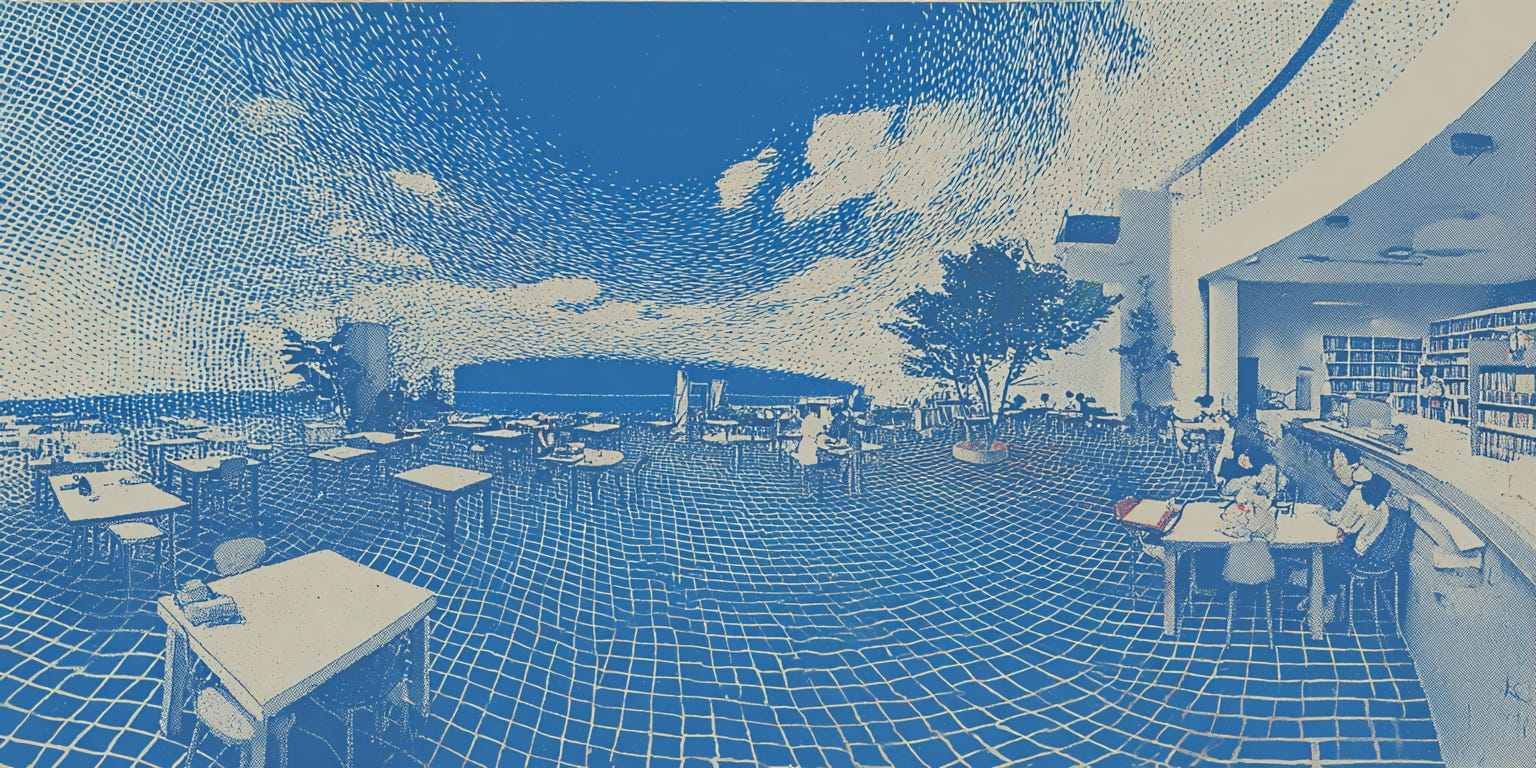
Three meals a day, every day. A 24-hour gym. High-speed wifi across campus. Access to a co-working space, a library, a cafe stocked with healthy snacks. A dense calendar of events: lectures, hackathons, debates, lunch and learns, vibe-coding sessions, language classes including beginner Mandarin, wellness programming. A daycare for families with young kids.
And something harder to put in a feature list: density of people who speak your language.
I don’t mean English. I mean the language where you can discuss about exit theory, on-chain governance, AI and sovereignty, or distributed statehood, and the person across the table already has context. In most of the world, including most of the cities you’d otherwise live in, such conversations stall at first principles. At NS, discussions start and end in more interesting places.
The NS online events platform recently migrated from Luma to NS’s own internal system. Small detail, but it signals something: the moment a community stops renting its social infrastructure and starts building and owning it is the moment it starts treating itself as permanent. There’s growing evidence of this both in the cloud, and on land.

Operating System
NS runs on a few interlocking models and commandments. “Learn, burn, earn” is the shorthand: learn new things, burn calories and bad habits, earn in whatever currency matters to you, financial or otherwise. “Win and help win” is an underlying ethic: individual growth and collective growth aren’t in tension, they reinforce each other. “Frontier not fancy” is the aesthetic: this is not a luxury resort with a governance layer bolted on. It’s constantly testing new ideas and planning for growth.
The slogans matter because they affect the daily environment. One where the pillars of daily life, food, fitness, intellectual stimulation, community, are handled at the infrastructure level so you can direct your attention toward whatever you came here to build or become.
The most honest endorsement I can give NS is this: it changed my defaults without asking permission.
You don’t rise to the level of your goals. You fall to the level of your systems. At NS the systems are good enough that falling to them is an improvement. My sugar cravings were gone by the end of week one. A diet soda habit I’d had for years just disappeared. I didn’t decide to quit either. The environment changed, and my behavior followed without a fight. I watched the same thing happen to people around me with their sleep, training, their work habits. Bodies don’t lie the way self-reports do, and seeing old friends who have lived here for months to years (the experiment is coming up on two years!), the time visibly shows: more muscle, less fat.
That’s the product underneath the product. Many co-living spaces give you a room and a co-working space and call it community. NS gives you an environment designed to help you level up health, work, and community, and bets that enough of those people in one place long enough will eventually constitute some durable community with political legitimacy.

Who?
About 550 people during my month in May 2026. Roughly half long-termers, half on monthly rotations. This was Ethereum month at NS, which overlapped with Solana Builders month that started the month prior.
At around 550 people, NS is past the point where everyone can know everyone. Culture can’t just travel through friendships anymore. It has to travel through meals, rituals, defaults, lectures, embodied norms, and the “boring” (but difficult to execute) infrastructure aligned for convenience and health. The demographic range surprised me, and it will surprise you if you’re just expecting a founder retreat for unattached twenty-something males.
There are families. Parents with young kids who signed up partly because of the daycare on campus and the meals that remove one of the largest logistical burdens of traveling with children. I met couples committed to the long-term track together. Saw kids running through the cafe, and met older adults looking for life stability and a place to stay on top of trends in technology. The broader population is already changing what the place has to offer. In that sense, Network School offers an increasingly wider slice of life, catering to a more diverse crowd beyond “fancy digital nomad retreat”.
The gender split has improved noticeably from earlier cohorts. The age range runs from children to older adults. The nationalities span more than 100 countries. The cultural layer is deliberately multilingual: English is default, but there are Mandarin classes running for kids and adults, a conscious push toward the kind of cultural pluralism that mirrors Singapore’s model more than it mirrors a typical Western tech conference.
The positioning is somewhere between East and West, online and physical, technical and civic. That’s the talent pool NS is trying to attract.
The core team is an important demographic. These are the people who live inside the product they’re building, eat the same meals, use the same gym, hear the feedback in real time, and iterate on it fast. I described them to a friend during my stay as the hardest working government employees I’ve ever met. They’re not real government employees obviously, but the analogy captures something: they’re running a civic infrastructure project with startup intensity and founder accountability. The feedback loop between what residents experience and what gets fixed is unusually tight because the people responsible for fixing it are also residents.
Intellectual Climate
The thing that surprised me most, returning after the conference circuit of the previous year, was how much the in-group quality had deepened.
At a conference you get high-density intellectual contact for a day or two with people you’ll probably never see again. The conversations are good, but the urgency and acuteness of the conference format makes it hard to foster enduring relationships.
At NS over the course of a month, that performance layer mostly drops. You eat breakfast together. You share elevators. You run into each other at 11pm in the cafe when both of you are still working. The conversations that happen in those unscheduled moments are often more interesting than the programmed ones.
What I noticed specifically was the absence of defensiveness. In a world with greater polarization both offline and online, it was refreshing to not have to spend cognitive energy establishing shared priors before you can get to the interesting parts of a conversation. At NS, that tax is largely gone. The priors about geopolitics, technology, political theory, and decentralization are widely enough shared that conversations can be more nuanced and go deeper.
The evening program offerings vary from substantive to atmospheric. Events like Is Ethereum a Network State? generated real debate. Founder-led discussions were honest about painful lessons learned in their career. The cross-pollination is real: watching someone from a DeFi background and someone from a longevity research background argue about incentive design. That kind of dinner-table collision says something about the conditions NS is dialing in.
NS and the society building on top of it, is creating a new kind of thing. How I’d describe NS is part campus, part co-living experiment, part startup accelerator, part civic prototype. The edges haven’t settled yet, but there are glimmers of emerging cultural scenes, norms, and rituals.
Perhaps eventually, there will be more visible nodes of different value systems and organizational primitives growing around the world.
I write a free weekly digest that covers this space, at Nodes Digest, and you can track the movement in our free dashboard at nsnodes.com
Human Texture
Every place has its own circadian rhythm and pace of life.
Here, new cohorts arrive at the beginning of the month, and the place gets a fresh wave of new energy. New faces, conversations, and projects in the room. That’s real and good, but not everyone stays as a long-termer. Friends you made three weeks ago board a flight and NS was just one chapter in their journey. The existing long-termers might feel this more than anyone: the recurring monthly cycles of excitement and grief that come from a rotating community.
The families I met had their own experiences. Parents loved not having to think about meals or childcare infrastructure for a month. Older adults found a way to engage as much or as little as they wanted with the community around them, on their own terms. The place turns out to have different shapes for different people, and the shape it takes depends less on the programming and more the kind of energy and engagement you bring to it.
The arc of a month matters too. The first week is novelty and orientation. The second and third weeks are where the real texture emerges, where you find your people and your rhythm. By week four you have enough context to know if NS is for you specifically. Many people I met were converting into long-term, which indicates healthy growth for the project.
Founder Dependency
Any honest review of NS has to reckon with its founder. Not because the place is reducible to one person, but because understanding his role is necessary for understanding what NS is trying to become.
Balaji’s pitch is roughly this: a nonviolent, positive-sum, techno-democratic society that can eventually negotiate with existing states. The influences are visible: LKY in the central clarity, Gandhi in the commitment to nonviolence and legitimacy through example.
The obvious risk is the bus factor. My worry with a project this early, with its legitimacy this tied to one founder’s vision, is that it carries a structural dependency. Then again, Satoshi also solo-mined the Bitcoin network in its first year. Satoshi was around to fix a critical bug and fork the chain before the network grew and eventually decentralized beyond the pseudonym. Founder phase isn’t a scandal. Even Bitcoin began with one identity making early judgment calls and patching the software. I see NS being in that early Bitcoin phase. Leaning on its founder and core team to prove the concept works, before the concept and vision can scale without them.
What I’m curious about is what comes after.
If NS can prove that internet-first societies can start, sustain, and scale, then what follows isn’t one network state. It’s many. Each with different rules, political innovations, justice systems, cultural norms, talent pools, values. Some will share a common origin and diverge gradually. Others will start from scratch and converge on similar solutions independently.
The Bitcoin parallel extends further than people realize. Bitcoin had its forks. Hard forks that created entirely new chains with different rules. Soft forks that changed the protocol while preserving continuity. What does a hard fork of a network state look like? A faction that disagrees on governance leaves and starts a new node with a different constitution? What does a soft fork look like? A policy change that shifts the culture without breaking continuity?
How value accrues across these societies, how cultural norms retain stickiness and embed themselves, how disputes get resolved when exit can be an increasingly affordable option — none of that has been tested yet. NS is one of the first durable nodes. What gets built on top of it, forked from it, or inspired by it is the part of the story that hasn’t been written.

Operations Beat Theory
NS is the most serious attempt currently running to answer a specific question the network state movement has been circling since its first conference: what does a permanent cloud community look like when you materialize it in physical space?
The pop-up city model proved you can compress trust and production into a month. The regulatory zone model proved you can negotiate real legal autonomy at the government level. What neither answered was permanence. How do you get people to stay? How do you build a culture and life that compounds across cohorts and even between generations, rather than resetting with every rotation?
The Network School experiment is one of the best attempts at that problem. What I observed in a month is that the answer involves things nobody covers in the theories of community building: 24-hour gym, healthy food, daycare and family support, in-house tooling. The operations. The unglamorous infrastructure of daily life that makes staying feel sustainable rather than like a temporary experiment.
The broader movement tends to over-index on governance theory and under-index on operations. The contribution of NS to the category, regardless of whether the political project fully succeeds, might be demonstrating that the operational layer is where startup societies actually win or lose.
Tokens are easy. Feeding people three times a day for years in a way that makes them healthier and more productive is hard. Getting families to commit to a year in a city still finding its population is hard. Maintaining intellectual density and cultural cohesion across rotating cohorts without losing continuity, is hard.
As it scales, NS is working on all of these problems simultaneously. The operating knowledge NS is accumulating may end up being more valuable than any single product built there.
Bitcoin works because anyone can inspect the machinery. What would it mean for a startup society to do the same? If NS eventually open-sources operational templates for building a community like this, the downstream effect on every startup society and community endeavor that follows could be substantial. Every physical node, Network School-adjacent or not, will have a working blueprint to build from rather than starting from scratch.
NS is beginning to prove that startup societies win or lose in the “boring” layer: food, fitness, families, tools, trust, and time.
Cost & Value

At $1,500 a month shared, $3,000 private, NS can feel somewhat expensive by Southeast Asian standards and relatively cheap by Western standards.
The honest accounting isn’t about comparing it to a Chiang Mai apartment. It’s about what you’re actually getting. Membership buys the removal of the decisions that drain you. What to eat, when to train, how to find like-minded communities, how to structure your days. You’re buying environmental design that makes healthier defaults. You’re buying optionality: career pivots, fundraising conversations, collaboration, mentorship, all available in the same building on the same day.
Budget some money for laundry, for the occasional meal outside campus when you need a change, and for the short trips to KL, Singapore, or elsewhere. Community members organize trips informally among themselves. They’re not mandatory, but they’re a healthy part of the longterm rhythm.
The people who get the most out of NS are probably those who arrive with a specific question they’re trying to answer. Something targeted: can I build here, is this the community I want to be part of, who in this building is working on the thing I should be working on next? The place rewards intention and staying longer than you initially planned.
Who Should Come
Creators, founders, crypto-curious, and people with a high agency relationship to technology. People at career inflection points. Remote workers who’ve lost the thread of why they went remote. Developers, researchers, builders who need a place to reorient. Anyone in the network state space curious to learn how technology is being applied to community and growth. Families who want a tested environment for a period of focused growth. Older adults who want regularity and community.
And honestly: anyone who suspects their current environment is holding them back and wants to test what happens when the environment is redesigned around healthier, positive-sum feedback loops.
Planning to try NS? I enjoyed my stay enough to recommend a visit.
My referral link gives you one week free (25% off) for your first month.

Support the Blog:
Decentralized Social Media 101: A Creator Flywheel. I’ve made a step-by-step guide with everything you need to set up and interoperate Farcaster, Paragraph, and Zora in one sitting.
Sponsor:
YODL Pay - Go global. Pay local. Use crypto in currencies around the world
Fascinating synthesis of experience. Much appreciated. I experienced the "absence of defensiveness" too. Delightful. Bowing in thanks :)
Thank you for this honest, thorough and compelling account of what life's like at Network School!